Kīlauea Update: North Vent Overflows Continue, Alert Level Stays at WATCH/ORANGE
Status as of the latest USGS HVO daily update, issued September 26, 2026, 8:41 a.m. HST (1:41 p.m. CDT), plus the HVO short message posted at 8:56 p.m. HST on September 26 (1:56 a.m. CDT, September 27). When this page was published, HVO had not issued a daily update for September 27.
- Kilauea
- Hawaii
- volcano
- eruption
- USGS
- HVO
- earthquakes
- Ring of Fire
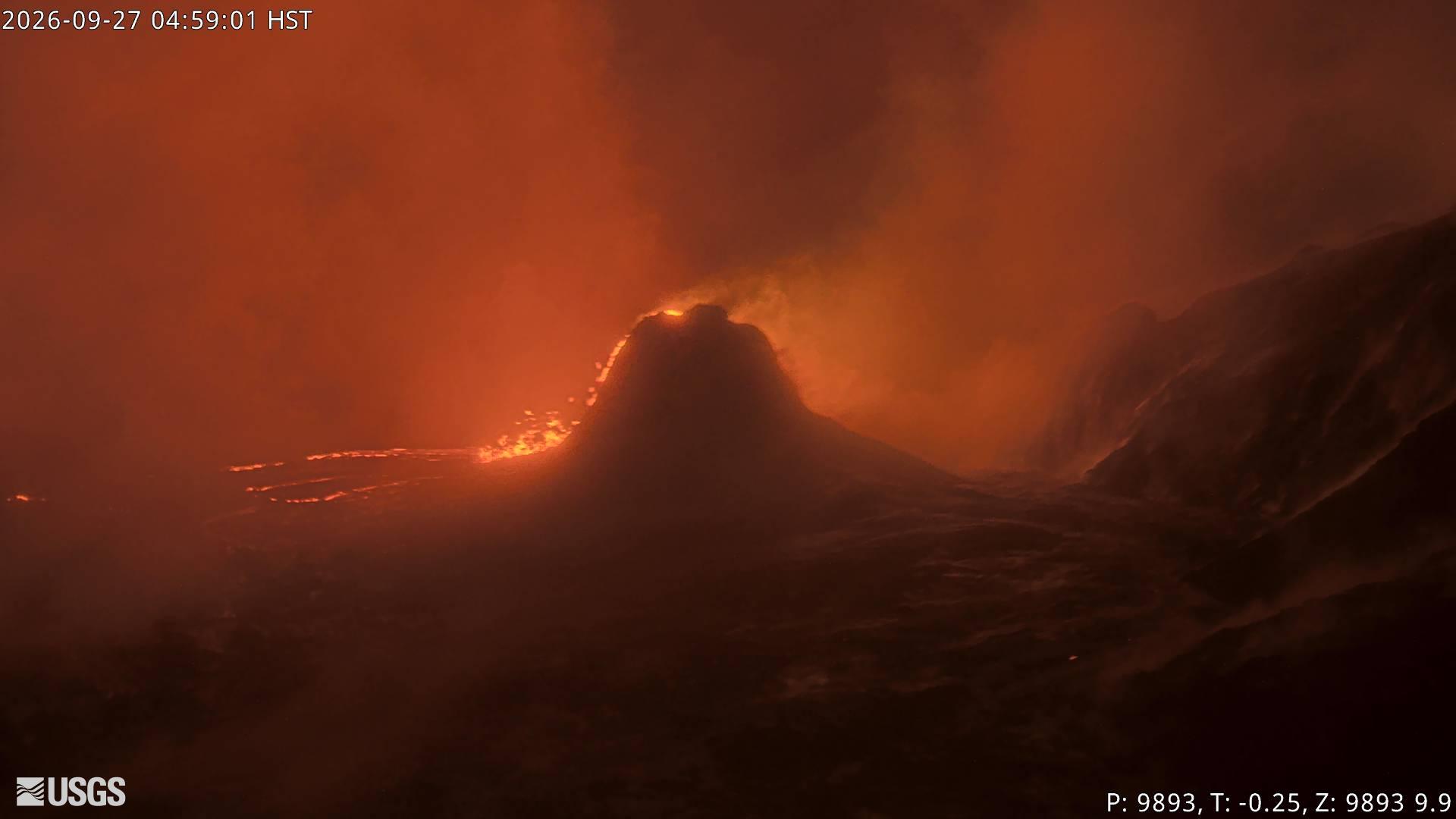
Kīlauea’s summit eruption in Halemaʻumaʻu crater remains active, according to the latest information from the USGS Hawaiian Volcano Observatory (HVO). HVO lists the Current Volcano Alert Level as “WATCH” and the Current Aviation Color Code as “ORANGE.”
In its daily update issued Saturday, September 26, at 8:41 a.m. HST, HVO said: “Small overflows from the north vent continue for the fourth day.” Precursory overflows from the north vent resumed on the night of September 22, and HVO counted 33 north vent overflows as of that update. Most lasted about 10 to 35 minutes and sent lava a few hundred meters from the vent. The north and south vents glowed strongly overnight with nearly continuous flames, while glow from the west vent was sporadic and weak.
HVO reported about 0.8 microradians of summit inflation over the prior day and said continuous tremor remains the dominant seismic signal at the summit. It noted no anomalous activity outside the summit region.
In a short message posted at 8:56 p.m. HST on September 26, HVO said there had been “8 more overflows from the north vent” since the morning update, that “Inflation remains high,” and that steam and clouds continued to obscure the vents.
On the episode count, HVO’s wording is: “Episode 55 remains a possibility during the ongoing Kīlauea summit eruption.” HVO also said forecast windows for this episode “can no longer be modeled.”
The eruption is taking place within a closed area of Hawaiʻi Volcanoes National Park. HVO’s update noted that Hurricane Nolo was affecting the island and that the park remained closed that day.
This is an update on current activity, not a forecast.
USGS update issue times
- HVO daily update: Saturday, September 26, 2026, 8:41 a.m. HST (18:41 UTC) = Saturday, September 26, 2026, 1:41 p.m. CDT
- HVO short message: Saturday, September 26, 2026, 8:56:49 p.m. HST = Sunday, September 27, 2026, 1:56:49 a.m. CDT
Background
The current eruption
The current eruption began at 2:20 a.m. HST on December 23, 2024 (6:20 a.m. CST). HVO calls it the ongoing Halemaʻumaʻu eruption, and describes it as episodic, from two vents (north and south) in Halemaʻumaʻu. In HVO’s words, lava fountaining episodes “generally last for less than 12 hours” and “are separated by pauses of two or more weeks.”
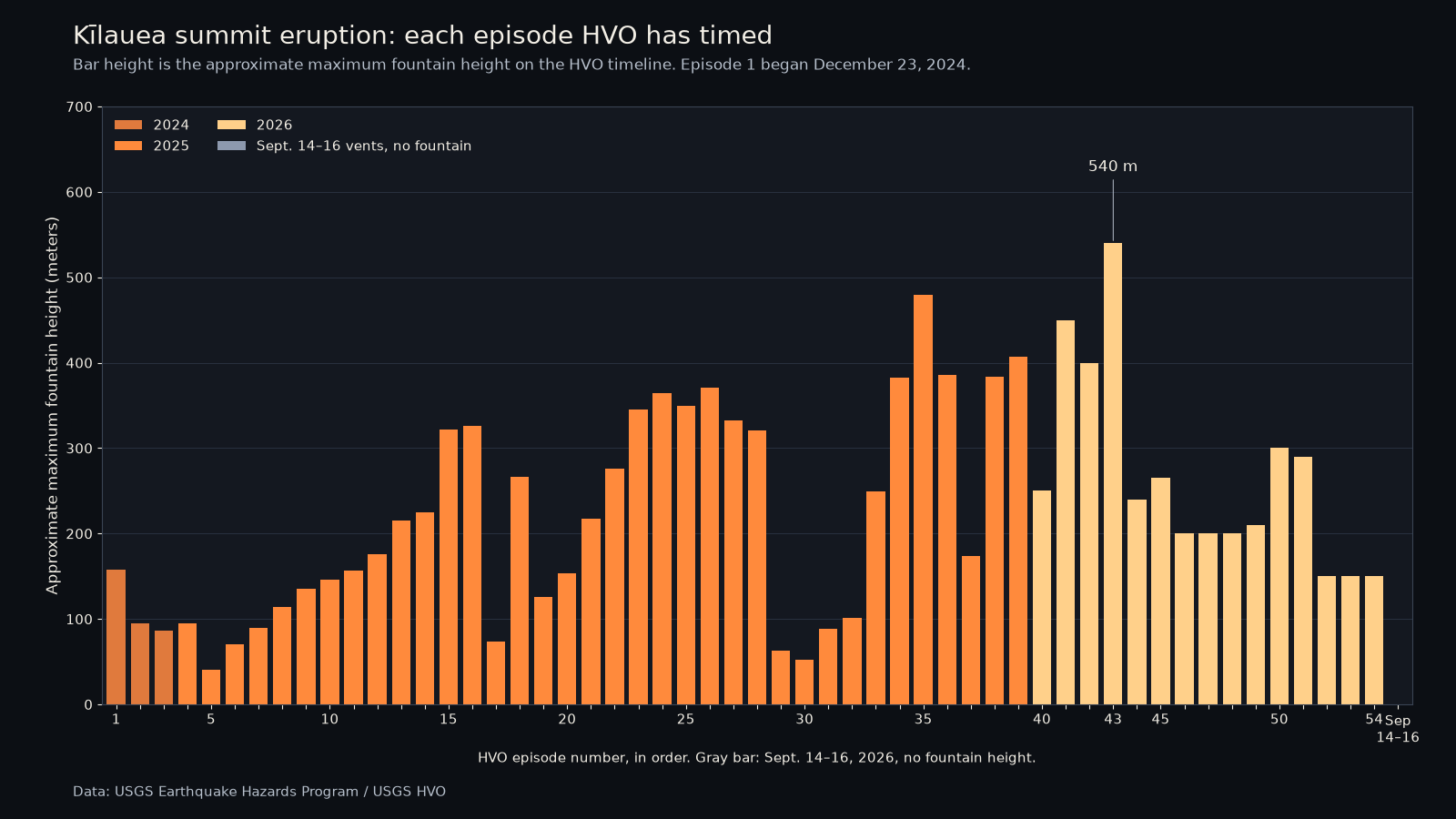
HVO’s eruption timeline lists 54 numbered fountaining episodes since December 23, 2024. The tallest fountain listed is about 540 meters (1,772 feet), in episode 43 on March 10, 2026. Mapped lava through episode 54 totals 312.6 million cubic meters, from an August 28, 2026, overflight that USGS published September 8.
Episodes and pauses
The 53 gaps between those episodes, measured from each episode’s end to the next one’s start on the timeline clocks, average 10 days, 19 hours (about 10.8 days). The longest finished gap, after episode 43, was 29 days, 16 hours and 49 minutes; HVO’s rounded pause column shows 30 days.
Episode 54 ended at 7:33 p.m. HST on August 25, 2026 (12:33 a.m. CDT, August 26). The current pause, now more than 32 days long, is still open, and HVO’s timeline marks it “TBD.” As of 5:07 a.m. HST on September 27 (10:07 a.m. CDT), it stood at 32 days, 9 hours and 34 minutes. HVO’s September 26 update put total summit inflation since the end of episode 54 at about 16.8 microradians, about 4 microradians more than was lost during episode 54.
Between September 14 and 16, 2026, lava erupted from six new vents on the summit without a numbered episode. USGS estimated that outbreak at about 0.4 million cubic meters. The September 26 update said there were no signs of reactivation of those vents.
The episode count, average gap and pause length are calculated from the start and end times on the USGS HVO eruption timeline, not printed by USGS as single figures. The timeline’s times are preliminary and its duration and pause columns are rounded.
Earthquakes: two 90-day windows
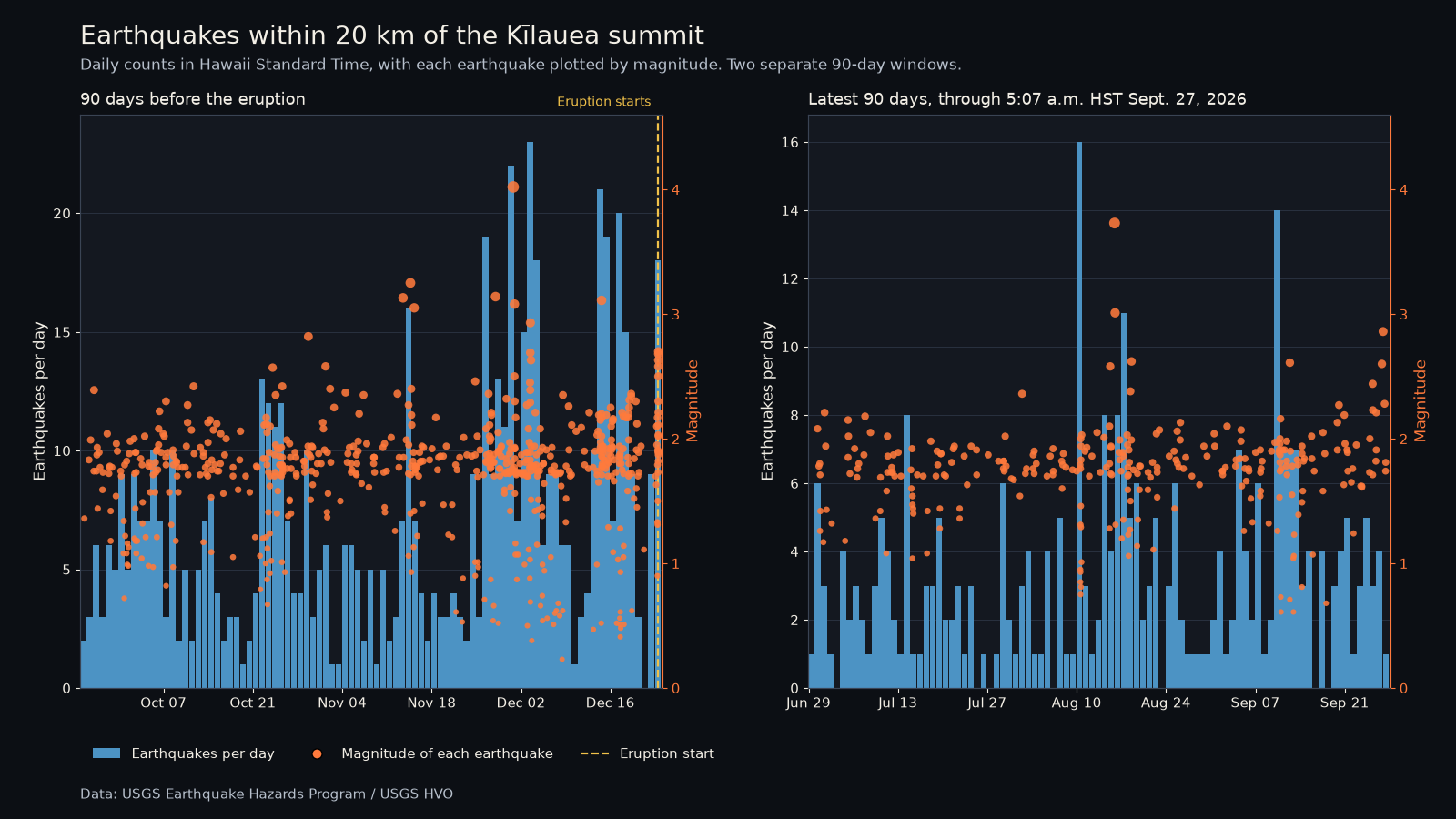
Within 20 kilometers of the summit, the USGS earthquake catalog (ComCat) lists 643 earthquakes in the 90 days before the eruption began. The largest was a reviewed magnitude 4.02 at 8:40 a.m. HST on November 30, 2024 (12:40 p.m. CST).
Over the latest 90 days, ending 5:07 a.m. HST on September 27, 2026, the same search returns 296 earthquakes. The largest was a reviewed magnitude 3.73 at 12:32 p.m. HST on August 15, 2026 (5:32 p.m. CDT).
Counts are calculated from USGS ComCat queries centered at 19.406° N, 155.283° W with a 20 km radius, and include both reviewed and automatic events. They describe past catalog activity and are not a forecast.
Longer history
Kīlauea’s East Rift Zone spent 1983 to 2018 in the Puʻuʻōʻō eruption, which USGS calls the longest and most voluminous there in more than 500 years. In 2018, the lower East Rift Zone eruption and summit collapse were the largest of either kind at Kīlauea in at least 200 years; the summit caldera deepened by more than 500 meters. The summit then stayed quiet until an eruption in Halemaʻumaʻu began at about 9:30 p.m. HST on December 20, 2020, followed by further summit eruptions through 2023.
Kīlauea is a hotspot volcano. Many people place it in the Ring of Fire, but this site’s corridor rectangles leave it outside; see the Kīlauea profile.
Follow the USGS Hawaiian Volcano Observatory (HVO) for official information: https://www.usgs.gov/observatories/hvo